

Misha Bereznyak and Naama Blonder
Building Charm
Architects, Urban Designers, and co-founders of Smart Density
Toronto, Ontario, Canada
BOOK COVER
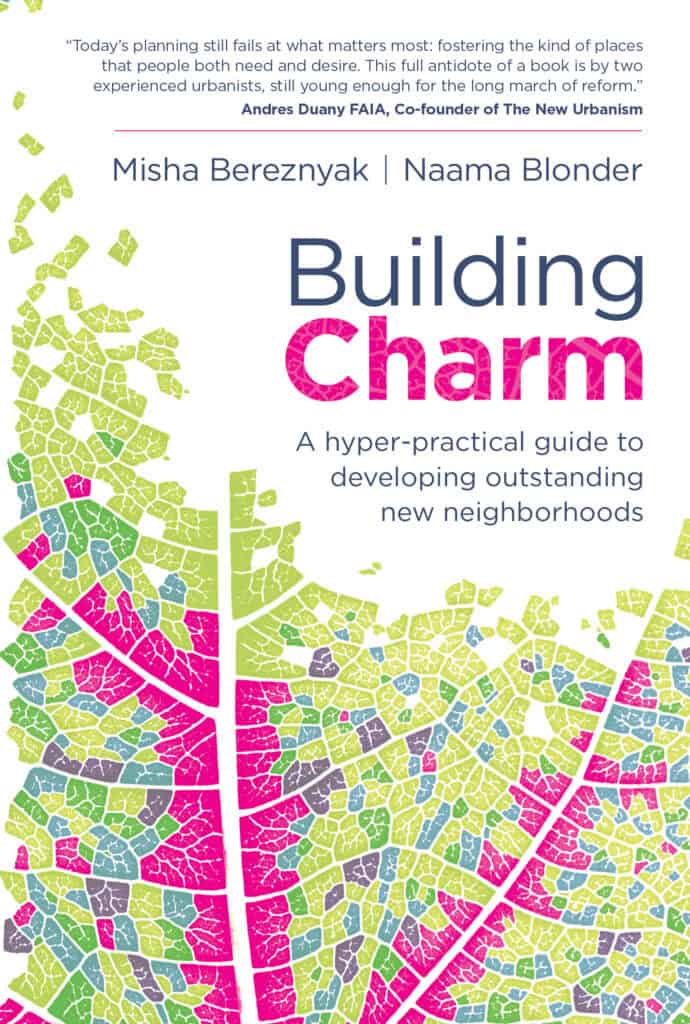
BOOK DETAILS
Pub Date: September 1, 2026
Genre: Architecture/Design
Publisher: Rethink Press
Page Count: 360
Format: Paperback
ISBN: 978-1781339671
Price: $25.99
ABOUT THE BOOK
The best old neighborhoods leave lasting impressions—but why is that so hard to achieve in new development?
Many new neighborhoods follow all the right design principles yet still fall short in delivering the human experience people value.
Building Charm presents a proven, practical system for creating genuinely appealing neighborhoods across a wide range of densities, from low-rise contexts to complex high-density environments.
This book will help you:
- Understand why new neighborhoods lack charm, despite meeting best practices
- Deliver genuine experiential quality without sacrificing density, practicality, or financial viability
- Organize pedestrian and vehicular networks that support real-world needs while creating comfortable, appealing public spaces
- Apply the Scaling Down system—a structured method designed for developers and professionals shaping new neighborhoods
- Design neighborhoods that people value and feel invested in, supporting enduring success and broad appeal
ABOUT THE AUTHOR
Naama Blonder and Misha Bereznyak are the founders of Smart Density. Drawing on global experience and extensive hands-on work, they wrote Building Charm to share the practical approach they developed through years of working on new residential neighborhoods within real development and municipal constraints.
Learn more at www.smartdensity.com
TALKING POINTS
- The Central Question: People travel to visit older neighborhoods, photograph them, and pay a premium to live in them, while few new neighborhoods inspire the same devotion.
- The Paradox of Progress: Despite more advanced planning practices and greater resources than ever before, new neighborhoods still fail to achieve the qualities of our best older neighborhoods. The book explores what went wrong, and when charm got lost.
- What Charm Actually Is: Charm isn’t nostalgia or a particular architectural style. It’s an experiential quality, shaped by how a place feels to walk through, linger in, and encounter in everyday life.
- The Human Scale Problem: One of the biggest structural barriers to charm is a lack of human scale, with streets, buildings, and open spaces that are simply too large for people to relate to.
- The Role of Cars: Cars have played a major role in eroding charm, reshaping neighborhoods around vehicular movement rather than everyday human experience. This raises the question of how to organize pedestrian and vehicular networks that support real-world needs without sacrificing livability.
- The Scaling Down System: The book introduces the Scaling Down system, a structural solution to these persistent barriers. It is built on a clear principle: elements required for contemporary functional needs, such as vehicular access, servicing, and higher density, should be arranged so they don’t shape the entire neighborhood.
- How It Works in Practice: Scaling Down is applied concretely to streets and buildings, including the role of a low-rise, closely spaced urban fabric, showing how design decisions at this level either enable or prevent charm.
- The Bigger Takeaway: Charm and modern development needs aren’t opposing forces. Scaling Down shows how neighborhoods can accommodate density, vehicular access, and contemporary requirements while still feeling human-scaled, walkable, and full of life.
PRAISE
“Today’s planning still fails at what matters most: fostering the kind of places that people both need and desire. This full antidote of a book is by two experienced urbanists, still young enough for the long march of reform”
—Andres Duany, FAIA, Co-founder of The New Urbanism
SAMPLE INTERVIEW QUESTIONS
- What does it mean for a neighborhood to be charming, and what are the qualities of an old neighborhood that we still desire today?
- Is charm dependent on architectural style, or on something else entirely? What factors actually create it?
- You describe charm as an experiential quality. What are the physical attributes and everyday experiences that combine to create it?
- What does it mean for a neighbourhood to lack human scale, and how can that be fixed?
- Have people tried to solve this problem before? Are there historical examples of neighborhoods that got this right, or attempts that fell short?
- What is the Scaling Down system, and how does it address the lack of charm in new neighborhoods?
- How should streets, open spaces, and buildings be designed to support charm? What role do different street types and the open space network play in that?

BOOK DETAILS
Pub Date: May 17, 2022
Genre: Memoir / Christian Inspirational
Publisher: She Writes Press
Page Count: 304
Format: Paperback
ISBN: 978-1647429003
Price: $15.99