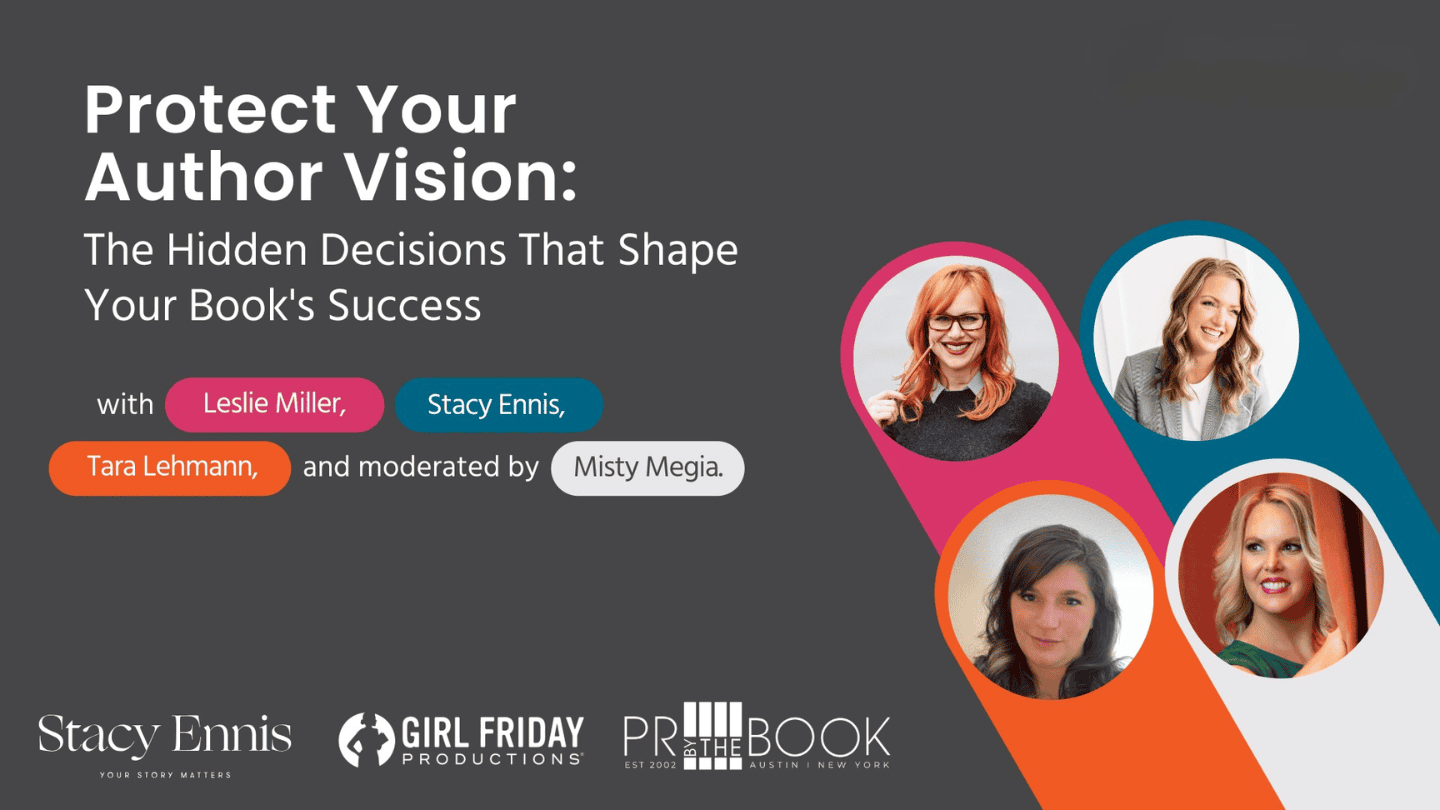
Protect Your Author Vision: The Hidden Decisions That Shape Your Book's Success
-
 prbythebook
- Reading Time: 24 Minutes

SHARE
We recently hosted a conversation with three industry veterans, Stacy Ennis, bestselling author and nonfiction book coach; Leslie Miller, co-founder and CEO of Girl Friday Productions; and Tara Lehmann, publicity expert at PR by the Book, moderated by Misty Megia. The discussion ran the gamut from first calls and red flags to AI, copyright, and the publicity decisions most authors don’t realize they’re making.
Below is a Q&A drawn from that conversation, with the panelists’ answers in their own words.
Q: Getting on that first call with a publishing professional can feel overwhelming. What advice do you have for authors just starting out?
Stacy: It is a big step. Getting on that first call with any type of publishing professional, at any place in the industry, can feel like, “Oh, I’m actually doing this thing.” So first, just know that the person you’re meeting with very likely is there because they love what they do and they want to help authors get their books out into the world. Most of us in this industry got here because we love books and we love authors. We’re on your team.
Next is to remember that this is a relationship. When you get on a call with somebody who might support you on your author journey, approach it like you would any other conversation, knowing that there’s give and take, and that you’re mutually exploring working together. In-demand publishers, PR people, book coaches like me, editors, they’re really busy, which means they’re also looking to see, “Is this somebody I can champion? That I can get behind, that I believe in?” So approach it from a relational standpoint rather than like an interview, or just a list of questions to fire at somebody.
Whatever stage you’re at is completely fine. We have seen it all. We’ve talked to authors that have zero words down. We’ve talked to authors that are on their tenth draft in ten years. So you’re totally fine wherever you are.
A couple practical things: do basic research about the professional and their company before you get on the call. Have a general understanding of what they offer, because they may or may not have the service that you need. And don’t be afraid to ask questions. No question is too simple.
Q: At what stage and in what order should an author work with each of you?
Leslie: Lots of first-time authors think this is a very linear process: “I’m going to work with a book coach first, then I’m going to produce my book, now my book is done, I’ve published it, and now I’m going to do PR.” Actually, what works much better is a more integrated approach. All of us have concerns with what the other one is doing. If Stacy is working with a client and they’re doing ideation, talking about book comps, or the positioning of their book in the market, that absolutely is going to influence what we do in production. Similarly, Tara wants to know what your cover looks like, what the back cover copy looks like. It’s all positioning.
We have people we’re working with who have gotten to the end and say, “Wait, I was about ready to push publish. Can I move my pub date out by five months? Because now my publicist says they would like lead time so they can try and get some coverage.” So it is never too early to talk to us. We talk to people all the time who don’t have a draft. Maybe they have an idea, maybe they’re somewhere in the dev editing phase. Even if you’re not going to work with us for six months, we’re happy to meet with you and help guide that journey upfront.
Q: How much does publicity actually care about cover design and positioning?
Tara: Even though we’re all taught not to judge a book by its cover, it is the first thing you see when you come across it. And it can very much influence not just a reader’s attention, but also the media’s attention. When we’re looking at the cover, we’re not only looking for how dynamic it is, we’re also looking for how it relates to the book, how it relates to the author themselves, how it relates to their backstory. We’re also looking at how it positions in the marketplace and how it holds up against other comparable or competitive titles.
If you have a genre you’re invested in — if you’re a romance reader, if you’re a science fiction reader — you often see trends in cover art. That’s because designers see something that works and flood the market with similar styles. We saw it happen with Casey McQuiston’s Red, White & Royal Blue, which spurred the heavy illustrative covers for romance books, and it continues to this day. So it really does require a book coach, a publisher, a publicist, and a marketer’s perspective in the conversation.
Q: What are publishing professionals really looking for when they evaluate an author?
Tara: It’s kind of a fallacy that the only thing we look at is your digital platform. The digital platform is absolutely important, especially in this day and age when so many of us can’t go further than five feet from our phones. But we look at so much more. We look at any contributed articles, any backstory information, your messaging and how it relates to your background. If you’ve got an academic background, how that relates to the messaging. We look at the overall temperature of the market for what you’re promoting, whether there’s a rising trend in certain topics, whether that trend has cooled.
It’s not just whether you’re mediagenic or photogenic, or can sit up to a microphone and record an interview, though that’s still very important. We also look at how you relate to the world around you and how you can comment on that. Because we are invested in you, we are invested in your book, and we are your champions. To do that, we need the full picture.
Q from attendee: It sounds like our personality and social media footprint really influence every step of the process. What do you recommend doing if we currently don’t have a strong social media presence and are a little shy about going online?
Georgie (with Girl Friday): Regarding being shy, I encourage authors to try to step out of that. Instead of thinking you are talking about yourself, shift your thinking to talking about the book. People tend to be a little more outgoing when they are talking about something they believe in vs. talking about themselves.
When you are talking about the book on social, it’s not a “Buy my book,” “Buy my book,” “Buy my book” message delivered over and over again. Instead, focus on WHY the reader should buy the book, what the reader will get out of it, what skills the reader will walk away with. Possible posts and content could include sharing chapters or pieces that were cut from the book, showing covers you didn’t choose, talking about the inspiration behind the book, etc.
People want to feel a part of something; they want “insider” information. Almost like they have a backstage pass and deeper connection to the content. One way to create that feeling is through social media. But it’s not the only way. You can grow your owned channels (i.e. website, blog, Substack, email list/newsletter, podcast, online, and in-person events) and still create meaningful reader engagement.
Q: What red flags and green flags should authors watch for when vetting partners?
Stacy: First, the bad news: this is a largely unregulated industry. It’s not like banking or real estate. You don’t have to have a license to be a coach or an editor. In a lot of facets of this industry, you can hang up a digital sign and call yourself the thing. So you really have to do your due diligence.
The good news is the internet is your friend. A few things I’d consider:
They have to pass the vibe check. I know that probably sounds like a funny thing to state first, but your intuition is strong. Don’t discredit your inner voice. I did an introductory call with somebody recently and felt awful when I got off that call. They talked down to me and belittled me as an entrepreneur. Even though they’d been recommended and had all the cred when I looked online, the feeling was not right. I knew I couldn’t work with them.
Make sure they have credentials — a bachelor’s or master’s degree in the area, proven professional experience, awards, bestseller lists, client testimonials, media features.
Red flags: No clear credentials. They can’t share client examples. They talk around things you ask for. If you ask for a book of a client in your genre and they send you one in a totally different area, or they don’t reply fully to emails, red flag.
Green flags: They follow up and follow through. They say, “I’m going to send you a proposal on Friday,” and it’s in your inbox on Friday. If something delays them, they email you saying, “I want a little more time to make sure this is really targeted for you.” Red flag is having to chase them.
One caveat on internet presence: a lot of amazing editors don’t have great websites. I wouldn’t discount somebody, especially a service provider, just because they don’t have an amazing internet presence. Just make sure they’re willing to share testimonials or examples.
Tara: Speaking strictly from a PR mentality, if you’re interacting with a publicist and they’re promising you all sorts of media coverage, that is a horrendous red flag. Publicity relies on our relationship with the media. We work with them, negotiate with them, but at the end of the day, we are also at the mercy of their editorial board. So any publicist who comes to you and says, “Oh, I can guarantee you feature coverage on the New York Times,” please do your due diligence. Rely on your gut check.
Leslie: A red flag is if during the call they have not said something you didn’t like. If they have only given you “yes, I can fulfill all your dreams, all your promises, check, check, check” — and they haven’t pushed back on any of it — I would call that a lack of transparency. Sometimes the best thing we can say is, “We’re not the best fit for you. What you really need is this over here.” We actually do care about your success, and we don’t want you to work with us if we’re not going to be able to help you. If they’re just sweet-talking you, that’s a red flag. Honesty is really important along with that vibe check.
Q: How do authors know they’re actually getting what they paid for?
Leslie: Publishing a book is a big-ticket item, financially speaking. You’re working with a lot of really skilled people for usually a long period of time, so you can expect it to cost quite a bit of money. Treat this like you’re hiring a contractor to redo your bathroom. You’re not going to talk to one contractor, you’re going to talk to a few. Do the vibe check. Compare proposals. Look at the full scope.
This is a really important business decision. Look at the fine print: How often are we going to meet? What are the guarantees you’re making? What are the deliverables? And understand clearly when we say we’re going to provide a service, that doesn’t always guarantee results. Tara could be working months for you and the result you really wanted didn’t happen. That doesn’t mean she didn’t put in tons of time and effort.
If we’re working up your first-round cover designs, sometimes you look and think, “This isn’t the direction I want.” We have a few more rounds to go. The fact that you didn’t get the cover on the first round doesn’t mean a designer wasn’t involved, doesn’t mean we didn’t vet them internally, doesn’t mean our team of 20 people wasn’t spending hours on your title.
Stacy: I’d add that once you’ve selected your partner, you also have to show up on your side. The authors who get the most value out of this work are the ones who do the work on time. They show up for the calls prepared. They create space in their lives to focus on the work and mindfully engage. You’re an entrepreneur in this process, so you need to treat it like that.
I see this especially in the publishing and PR process. Sometimes it’s hard to compare publishing proposals because publishers use different language and include different things. Authors come in and haven’t really understood what marketing is included. Or maybe they hire Tara and they think she’s going to be pitching speaking engagements and book awards and media, but the scope is podcasts and article features. You really have to understand what the professionals are doing for you.
Tara: There’s some real difference between marketing and PR, and sometimes there’s an educational back-and-forth. While we always include scope of work in the proposal, sometimes things come up. For instance, at PR by the Book, we generally don’t do author events. Within the scope of our work, it’s not something we do. However, we’re happy to offer guidance and point you in the direction of people who do.
Q: What are concrete steps to find women-led and diverse publishing professionals who will advocate for your book?
Tara: Google and the internet continue to be your friend. Definitely do your research and your due diligence. But also talk to your community. Talk to the people you regularly communicate with in the writing community, in your friend base, even amongst family. See who they’ve worked with. To an earlier point, sometimes publishing professionals don’t have the best website presence, so word of mouth continues to be very strong.
If you’ve already brokered a conversation with one of us and determined we’re not the best fit, ask us. See if we can point you toward a vendor or contractor that better fits your needs, whether that’s women-led, specifically nonfiction, specifically fiction, or something more specialized like graphic memoir. It is a small industry. There’s a high chance that we can at least offer you direction. As Misty put it: race horses don’t recommend donkeys.
Leslie: There are also organizations that can help you. The Authors Guild, for example. You have to be a published author to apply, but they offer services and advocacy for free. They have really robust discussion groups, and if you get to the contract stage, they have draft contracts. So you can look at one and ask, “Does the scope of this seem reasonable?” without hiring a lawyer. There are other organizations like Alliance of Independent Authors as well, with vetted vendor lists.
Q from attendee: I have a question about launching a 2nd edition of a book. I am ready to go and wanted to know if a new campaign is necessary.
Tara: Short answer is no, not really—but the much longer response begins with another question, are there significant changes in your second edition? I won’t suggest it warrants a whole new campaign if there are, especially since they’re the same book in essence still, but it’ll offer expansion for your initial campaign and can offer new meat for media interest. But I would not recommend leading with any new outreach on the fact that it’s a second edition, just lead with the additional information. Feel free to release your second edition!
Q: What should and shouldn’t authors be using AI for?
Stacy: I just got back from the London Book Fair a few weeks ago. AI was in at least half of the programming for the four days I was there. What I heard over and over again from agents and from publishers is that if they even have one line of generative AI in a book, they’re not willing to take the risk on that author.
We have to separate creative generation from using AI as a tool to support the development of your work, like gathering research. I am shocked at how quickly authors are relying on AI as part of their thinking process. It’s actually stunting them in the ideation process. If you use AI in your ideation and generation, it will guide you in a similar direction it’s guiding everyone else. Which is why I’m seeing four-part book outlines come in that are the same structure outline, whether someone’s using ChatGPT or Claude. AI often shuts authors off in their creative process. Authors think it’s supporting them, but when I have conversations with them, it’s actually guiding them away from their core, away from their original thinking. Authors are creating outlines that have no passion, no dark night of the soul to get to clarity, no real deep drive.
For that reason, I would highly advise that you do not use it for ideation and you do not use it for any generation whatsoever. There are ways AI can be powerful. We use it in our business; we’re working on developing a tool to support authors with accountability. It’s great for things like finding specific research or data points. That’s an amazing use for AI.
If you want to understand it better, Anthropic has a free certification program you can go through. It’s really well done and simple. I’m not afraid of technology, but I also believe we’re in a place where we need to lead the ethics around AI usage in creative work.
If you have used AI in any capacity, you need to disclose that to the professionals you’re working with. And you should ask professionals how they use AI, because I have seen problems where editors or other people in the process will upload an author’s work, and that is a big problem for you.
Q: What happens to your copyright when you upload your manuscript into an AI tool?
Tara: Recently, one of the major publishers in North America had to pull back a book that was set to go on sale very, very soon, simply because they determined it was written, even in small part, using generative AI. The book had already been published in the UK, so it was already on sale there. The book is called Shy, and it was yanked the moment they determined generative AI was used. Every publisher since then has had some sort of commentary on this. Where AI before in publishing was seen as more of a positive in the creative process, now it’s being looked at as the devil on your shoulder.
The reason we’re all concerned is because the minute you upload your manuscript into any chat AI function — Claude, ChatGPT, what have you — it’s essentially used in the AI aggregate, and they can use it to train other AI. You potentially lose your copyright over whatever you have just spent months and months writing. So we do not recommend you upload any portion of your manuscript to ChatGPT, Claude, what have you, for that very reason. We want you to maintain copyright control over your book.
Stacy: Even if you uncheck the learning settings in the AI, we cannot trust these tools at this point. Even if you go into settings and say “don’t use this to train,” I still would not advise it.
Tara: I had this conversation yesterday with an author for digital purposes. I was helping her with her social media campaign, and I had to tell her while you’re building this campaign, do not use whatever manuscript portions you have to help develop your social media. Because it’s going to take it, it’s going to train, and you’re going to lose any leverage you potentially had.
Leslie: As an author, I filed a claim.Some of my books were part of the Anthropic class action lawsuit, so I’m a plaintiff there. For people who don’t know, those were books that were used without permission to train the models. I think a lot of people don’t understand how it works. They think it’s magic that you’re saying it and it’s giving you original magic. It’s not. It’s aggregated other people’s magic that it’s giving you. And sometimes it’s not magic at all.
This is what I deal with every single day now. I’ve had to change our contracts multiple times. All of our master services agreements with all of our contractors. We work with hundreds of skilled professionals, so we have very clear guidelines on how they may not use AI in their work, because we have promised we’re not going to use it in your work when you sign up with us.
People also don’t understand that you might not be eligible for awards. Some people won’t give you a review. It changes every day. So you’re actually really limiting your possibilities.
I understand a lot of authors use AI because it gives them power. I understand what it’s like to enter into a business and not know what you’re doing. But to Stacy’s point about stunting creative possibilities, we have authors come in now and say, “Well, I asked ChatGPT to make me a cover and here it is, and this is what I would like.” I get that’s your idea of what you would like, but we have an art director who’s choosing a designer for your cover based on your genre. They probably work at Random House on their covers as well. We’re bringing all this experience about what a genre cover should look like, what it should do, who it’s appealing to. Using AI on your own, you’re wasting your money spent on expert help. The image AI gives you was built on other people’s images, so the artists and designers are also sad about that. I understand wanting to seize that power, but choosing professionals to help you instead is really the way to go.
Q from an attendee: What should authors do now if they have uploaded their original work into ChatGPT? Should they scrap everything?
Stacy: No, don’t scrap everything. If it’s you-generated (not AI-generated), that’s still your work. That said, if you haven’t written much yet—maybe a few pages or so—I might be inclined to start from scratch. Be sure to stay up to date on court cases related to situations like yours.
And for future reference, I recommend going into the settings of your LLM (Claude, Chat, etc.) and deselecting the option that allows AI to train on your work. Even with this unchecked, though, proceed with caution when uploading anything you’ve written.
Q from an attendee: Can authors protect against agents or publishers uploading their work into AI for their own purposes?
Stacy: Currently, there is no way to fully protect yourself from another professional uploading your work. And until there are clear laws around this, which could take a very long time, asking is your best protection. Best practice is to directly ask the professional’s AI policy before sending your work, or to explicitly request that your work not be uploaded into any AI platform.
For example, if an editor or publisher requests your manuscript, you might say something like: “I’d be glad to send over the full manuscript. Before I do, can you clarify your AI policy? I want to ensure my book and accompanying materials are not uploaded into a large-language model like Chat GPT or Claude.”
Here’s where it becomes imperative to work with professionals you trust, and to do your homework before sending your work out into the world. It’s your book, your copyright, and your work. Trusted professionals will protect your work like it’s their own.
Q from an attendee: I have a draft done, but I am not great at illustrations. I know what I want the illustrations to represent, and AI can spit them out quickly. I am hesitant to go that route… thoughts?
Leslie: Most writers aren’t illustrators, but I caution you against filling the gap with AI. Some considerations: First, depending on genre, the illustrator is a key contributor to the book and the right fit is essential to the project coming together. Existing art might not match the copy once it has undergone editing and the choice and style of illustrations depend on inputs from design, marketing, and editorial. Now for AI. Remember that AI is not coming up with original designs for you. Rather, it is combing through existing material to piece together what the code interprets you are asking for. Generating images in this way also makes moot the expert advice and consultation from publishing experts on the book design. Publishers expect to participate in the design of the book and the packaging and are well-equipped to do so. Some publishers will not work with you or that AI-generated material, and if it is included, you might be excluded from certain reviews programs or award competitions. I would just describe in your pitch or submission your ideas for art in the book, its proposed style and function, and go from there.
Q: What’s the most rewarding part of this work for you?
Stacy: One of my favorite things is getting an unboxing video from my clients when they receive their first box of books. They open the box, and I watch their face: studying the book, turning it over, often with tears in their eyes. Just seeing that is so beautiful. Normally I’ll get a really nice handwritten note in the mail. To see their joy, to see what they’re out doing in the world, to see them realize that goal. One of our core values as a team is celebration.
I had a mutual connection with Misty, a past client named Regina Lawless, who was just featured in the Wall Street Journal, huge spread, photographers at her house, awards. Hearing from somebody that a book saved a life, changed a life, changed the trajectory of a life, that’s not me—you did the work, but to have a part in that is realizing the seven-year-old me’s dream of getting to work in books and getting more books out into the world.
Tara: I love helping people match their passion for their books. I came to publishing because I love to read, like everybody else, but I also loved learning and didn’t want to go through academia. I love having the opportunity with each new project to learn something new and connect with a whole range of people who bring new experiences to me that I’m not in a position to have myself. I love being able, from backstage essentially, to help them realize their opportunity to share their vision and their own stories.
Leslie: We have something at Girl Friday we call the Girl Friday Experience, which is really our main selling point. We make amazing books, that is true. But more than that, writing a book, publishing a book, publicizing a book is an incredibly vulnerable act. I’ve done it. I recognize that vulnerability, that fear. “I’m about to put this out. I’m about to walk naked out into the world. You all get to comment on it, say things, maybe you love it, maybe you don’t love it.”
People come into this journey with that fear and vulnerability, and sometimes not a lot of information about what’s going to happen. To make that safe and joyful and help them produce the very best possible iteration of what they’ve been dreaming about is really a gift. It almost feels like therapy sometimes. I love it when people don’t want to leave us, when they’re like, “But we don’t get to talk anymore!” I love it when they come back. Publishing a book should be fun. It’s hard, but it should be fun, and it should be participatory and joyful and cool. When we do that for people, I love that.
Q from attendee: Can we talk about the cost for each of the speakers in the non-fiction field?
Leslie: From GFP, comprehensive publishing packages average around 35K, depending on the book’s genre and length, the distribution pathway, the scope of services and formats, and the proposed marketing plan, among many other factors. That’s why we do a custom bid for each project based on the needs of the book and goals of the author. Our production takes around nine months, ideally starts from developmental edit moving forward, and assigns to each author a minimum of four dedicated in-house team members along with a curated team of outside experts in editorial and design whom we manage.
Tara: PR by the Book’s plans and pricing can be found here.
This post is adapted from our recent webinar, Protect Your Author Vision: The Hidden Decisions That Shape Your Book’s Success, featuring Stacy Ennis, Leslie Lamb Miller of Girl Friday Productions, and Tara Lehmann of PR by the Book, moderated by Misty Megia. If you’d like access to the full recording, feel free to reach out. We’d be happy to share it.

prbythebook
How Book Publicity Can Open Doors Beyond Media Coverage
How Book Publicity Can Open Doors Beyond Media Coverage SHARE
How to Build a Media Wish List with Reach and Relevance
How to Build a Media Wish List with Reach and
The Ideal Book Publicity Timeline: When to Start and What to Expect
The Ideal Book Publicity Timeline: When to Start and What